

The Quick Answer: What Health Coaches Really Make
Employed health coaches typically earn $45,000 to $70,000 a year. Self-employed and board-certified coaches see a far wider spread: 36% of NBC-HWCs earn under $10,000 a year from coaching, and only 7% clear six figures. Private-practice sessions run about $100 an hour on average, but that’s gross revenue, not take-home pay.
What’s covered:
- Real salary data from five independent sources, not certification marketing pages
- What board-certified coaches actually report earning
- How employed and self-employed income differ
- What actually moves the needle on pay
- A realistic year-by-year income timeline
Google “health coach salary” and you’ll see numbers scattered anywhere from $45,000 to $200,000 or more, often on the very websites trying to sell you a certification. So how much do health coaches make, really? Certification schools have an incentive to show you the biggest number they can defend. This guide doesn’t.
It draws on independent salary data from ZipRecruiter, Salary.com, PayScale, and Indeed, plus the National Board for Health & Wellness Coaching’s 2025 survey of 2,328 board-certified coaches, the closest thing this industry has to ground truth. No sales pitch, no cherry-picked outliers.
You’ll get the real employed-coach salary range, what board-certified coaches report earning in private practice, how full-time and part-time income differ, what actually affects your earning potential, and a realistic timeline for building income if you’re starting today.

AFFILIATE DISCLAIMER: The Gardener’s Gentle Reminder
In the sprawling garden of the internet, some of the seeds we plant are special. If you choose to water them (aka click on affiliate links and make a purchase), we might get a sprinkle of support in return. It helps us keep the garden lush and vibrant without any extra rain from your pocket! Rest assured, our green thumbs only point you towards products we truly believe could make your garden flourish, too.
The Short Answer: Health Coach Salary at a Glance
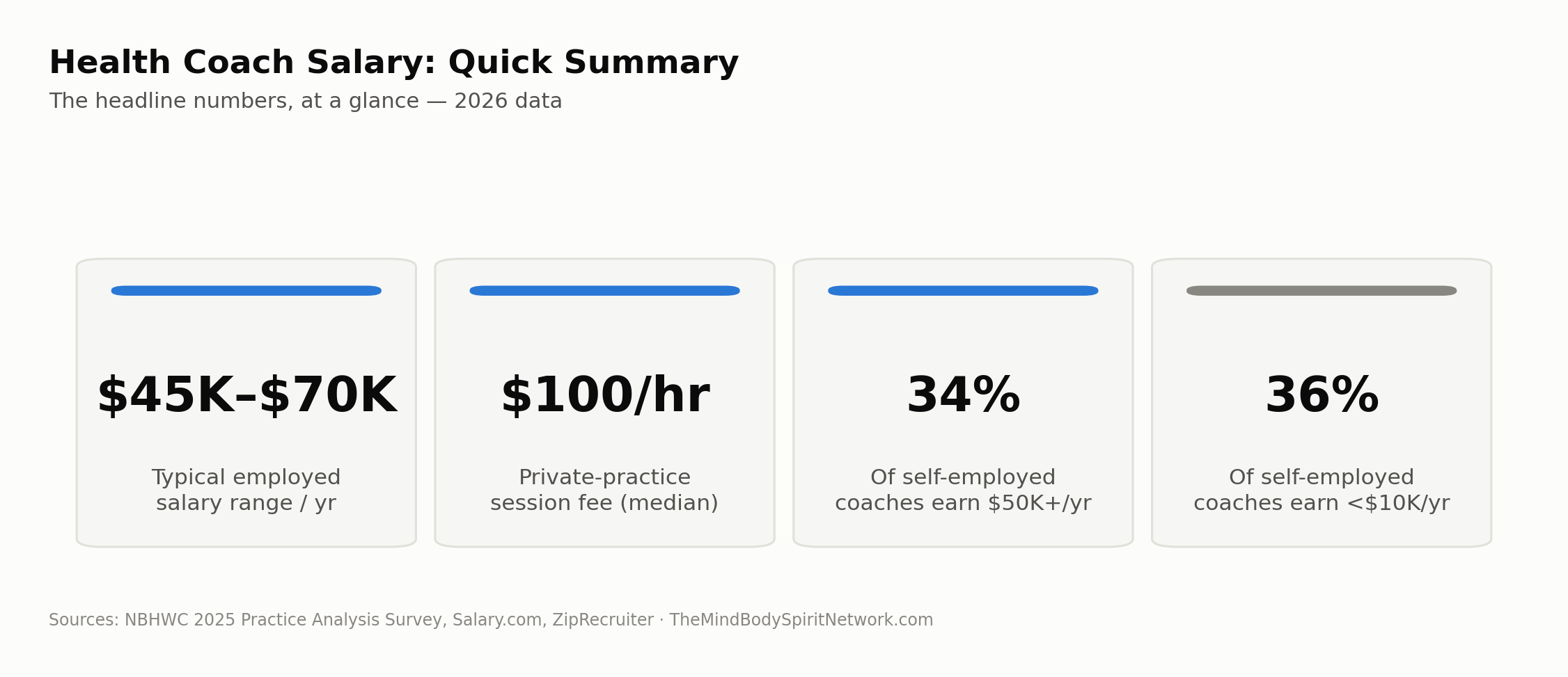
Employed health coaches in the U.S. typically earn between $45,000 and $70,000 a year. That range comes from averaging four independent sources: ZipRecruiter ($48,790), Salary.com ($61,600), PayScale (about $53,539), and Indeed (about $55,557). None of these are certification-school marketing numbers.
Health coach income looks different once you factor in self-employment. Here’s the quick-reference comparison.
| Source | Central Estimate | Published Range |
|---|---|---|
| Indeed (Sept. 2026) | $26.71/hour (~$55,557/yr) | $11.78–$60.58/hour |
| ZipRecruiter (Sept. 2026) | $48,790/year | $26,000–$72,000 |
| Salary.com (Sept. 2026) | $61,600/year | $45,170–$77,075 |
| PayScale (2026) | $25.74/hour (~$53,539/yr) | $18.40–$47.50/hour |
The self-employed reality check.
In NBHWC’s 2025 survey of board-certified coaches, 36% earned under $10,000 a year from coaching, 34% earned at least $50,000, and just 7% earned $100,000 or more. Private-practice session rates centered near $100 an hour, but gross fees aren’t take-home pay.
What Does “Health Coach Salary” Actually Mean?
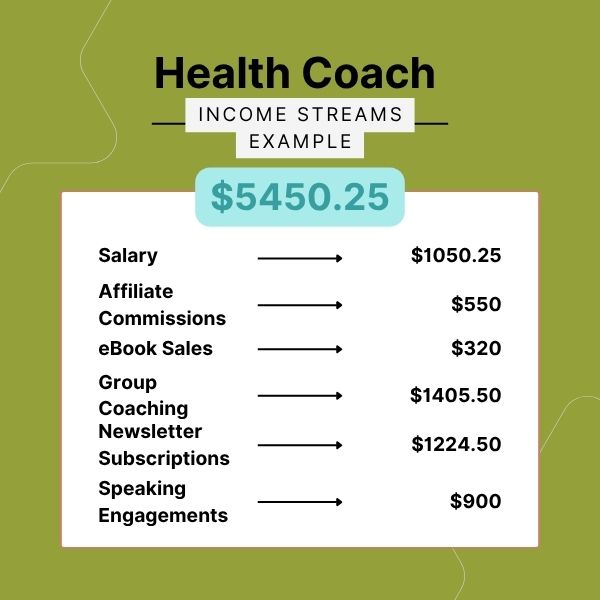
“Health coach” covers salaried healthcare jobs, hourly digital-health roles, contract work, side businesses, and full private practices. Those aren’t interchangeable, and neither is what gets measured about them.
Salary or wage.
Compensation paid by an employer.
Coaching income.
What a person actually receives from coaching. May combine wages, contract fees, and business income.
Gross business revenue.
Client receipts before software, insurance, advertising, payment processing, education, and taxes.
Session price.
What a client pays for one visit. It is not the same as your hourly wage.
Why there’s no official “Health Coach” job code.
The Bureau of Labor Statistics doesn’t publish a standalone wage series for health coaches. O*NET’s keyword search maps the term across several occupations instead of one. Health Education Specialist is the closest commonly used proxy, but that role includes designing population-health programs, which is broader than one-to-one coaching. Wellness coach salary and health and wellness coach salary searches run into the same problem: there’s no single government number behind any of these titles.
Health Coach Salary by Source: Independent Data vs. Certification-School Claims
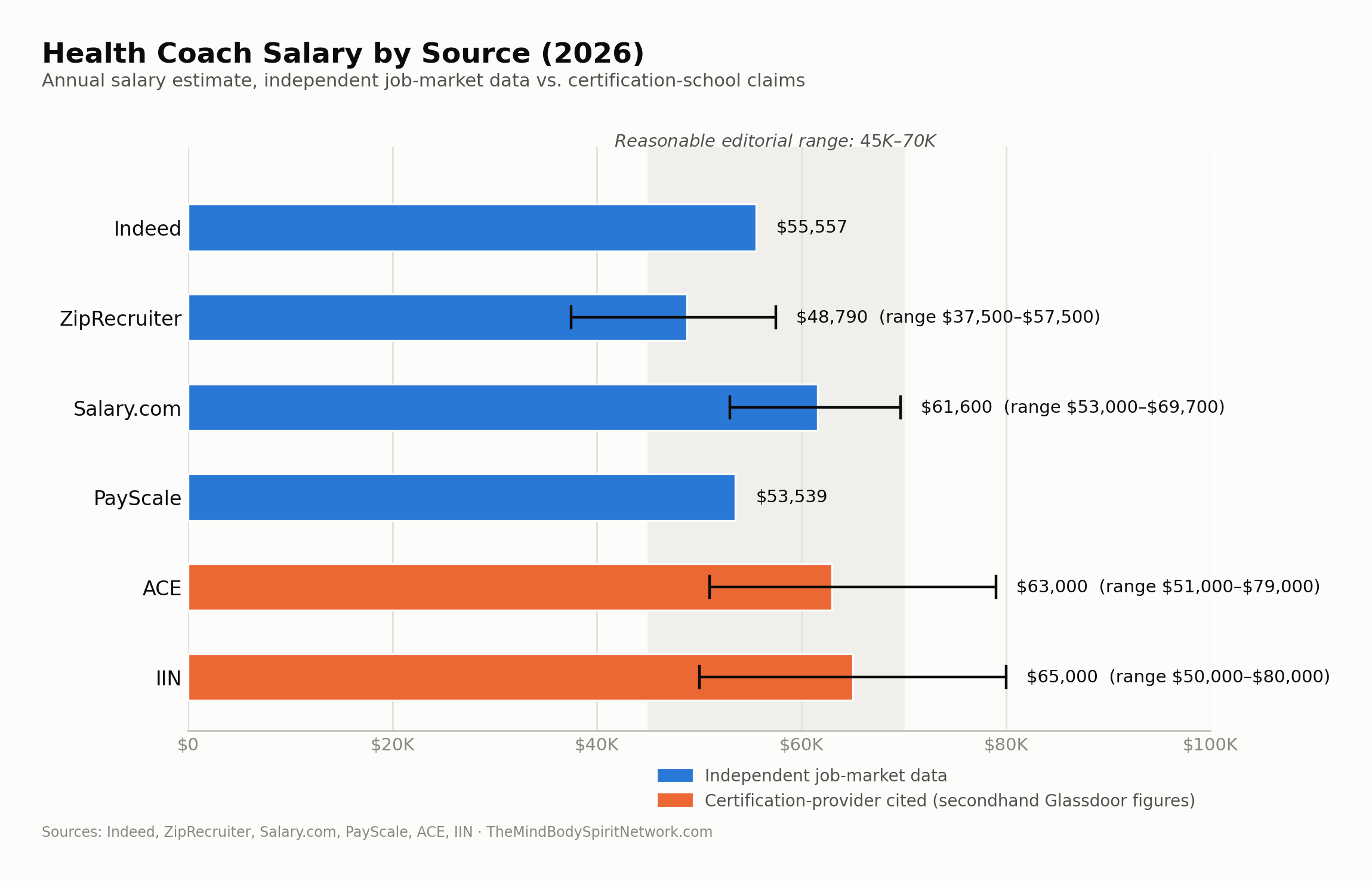
Independent job-market sites and certification schools tell noticeably different stories, and the gap matters.
| Source | Figure | Independent or Provider? |
|---|---|---|
| Indeed | $26.71/hour, based on 2.8K salaries | Independent job-market aggregator |
| ZipRecruiter | $48,790/year | Independent job-market aggregator |
| Salary.com | $61,600/year | Independent compensation data |
| PayScale | $25.74/hour | Independent, employee-reported |
| ACE | $63,000/year ($51,000–$79,000) | Certification provider, citing Glassdoor secondhand |
| IIN | $50,000–$80,000/year | Certification provider, citing Glassdoor secondhand |
Notice the pattern. The independent aggregators land in a tighter, more conservative band. The two provider pages, published by schools selling the certification, both cite Glassdoor figures they don’t independently verify and both land higher. That doesn’t make them wrong. It makes them worth reading with a critical eye. A reasonable, evidence-based editorial range for an employed health coach is $45,000 to $70,000 a year, with specialized clinical, corporate, or high-cost-market roles able to exceed it.
Health Coach Salary by Experience Level
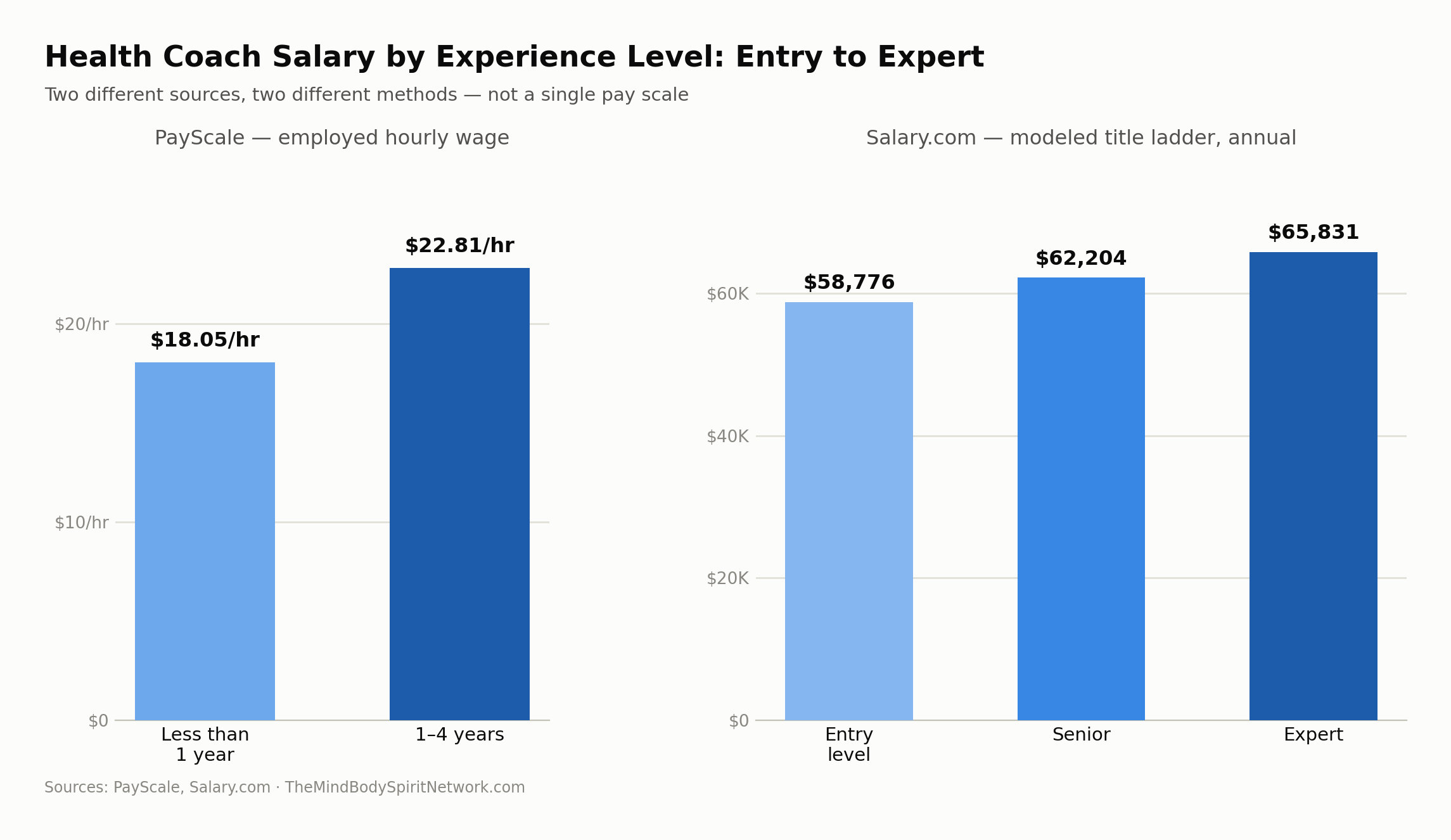
Experience moves the number, but the published data is thinner than you’d expect for a growing field.
| Experience | Reported Pay |
|---|---|
| Less than 1 year | $18.05/hour (PayScale) |
| 1–4 years | $22.81/hour (PayScale) |
| Entry level | $58,776/year (Salary.com) |
| Senior | $62,204/year (Salary.com) |
| Expert | $65,831/year (Salary.com) |
The jump from entry to expert on Salary.com’s modeled ladder is real but modest, about $7,000 over a full career arc. NBHWC’s own survey adds a more useful directional finding: coaches with 3 to 6 years in coaching-related roles had the highest proportion earning at least $50,000. Experience matters more for stability than for dramatic pay jumps.
Employed vs. Self-Employed: Two Very Different Incomes
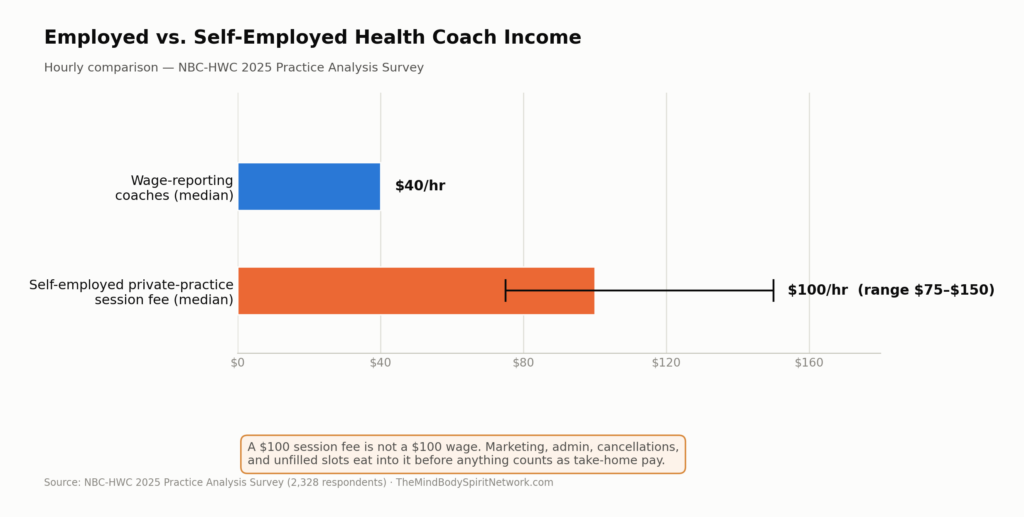
Most board-certified health coaches are not employees. NBHWC’s 2025 survey of 2,328 respondents found 58% self-employed, only 28% working full time, and 44% working part time. Private practice was the primary setting for 41%.
Why a $100 session fee isn’t a $100 wage.
NBC-HWC private-practice sessions run a $100 median, with most falling between $75 and $150 an hour. But wage-reporting coaches across the board show a $40 median hourly wage. The gap isn’t a mysterious “self-employment tax.” It’s unbilled hours: marketing, admin, cancellations, and the client slots that don’t fill. Private-practice fees have to cover all of it before anything counts as take-home pay.
The income distribution reality check.
This is the number that matters most if you’re weighing whether to go independent: 36% of NBC-HWCs earned under $10,000 a year from coaching, 34% earned at least $50,000, and only 7% earned $100,000 or more. Among full-time coaches specifically, 34% earned at least $75,000, which tells you full-time commitment changes the picture substantially.
How Much Do Health Coaches Make by Business Model?
How you structure your offer changes your income potential more than almost any other decision you’ll make.
One-to-one sessions and packages.
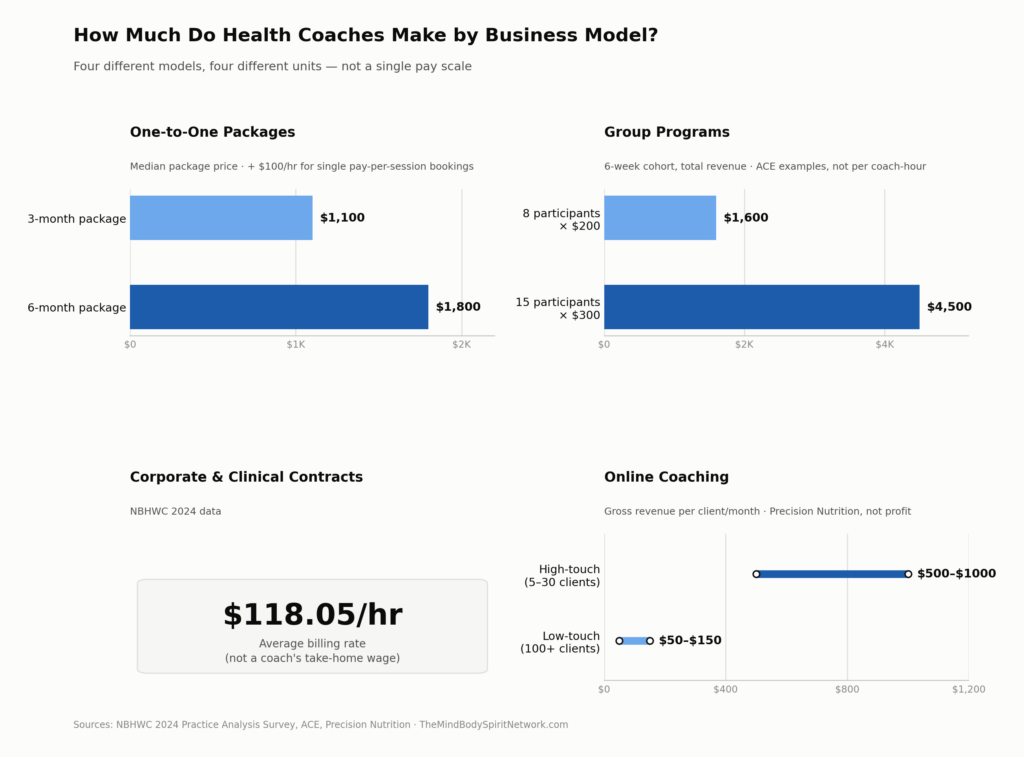
NBC-HWC pay-per-session rates median around $100/hour. Packages improve cash flow: NBHWC’s 2024 data showed a $1,100 median for a 3-month package and $1,800 for 6 months. Straightforward to launch, but capacity is capped and acquisition time is unpaid.
Group programs and workshops.
ACE’s examples show a six-week group at 8 participants and $200 each generating $1,600, or 15 participants at $300 generating $4,500. Better revenue per delivery hour, but enrollment and retention become the real constraint.
Corporate and clinical contracts.
In NBHWC’s 2024 data, corporate client fees averaged $118.05/hour, though that’s a billing rate, not a coach’s take-home wage.
Low-touch vs. high-touch online coaching.
Precision Nutrition describes low-touch models at $50–$150 per client per month with 100+ clients, and high-touch coaching at $500–$1,000 per client per month with 5 to 30 clients. Both are gross revenue ranges, not published profit numbers, and churn and acquisition costs aren’t factored in.
Whatever model you choose, pricing confidence is its own skill, separate from coaching skill. If undercharging is holding your income down more than your business model is, Evolving Wisdom’s Charge What You’re Worth is worth a look. It’s built specifically for practitioners who know their work has value but haven’t figured out how to price it that way.
Health Coach Salary by Location
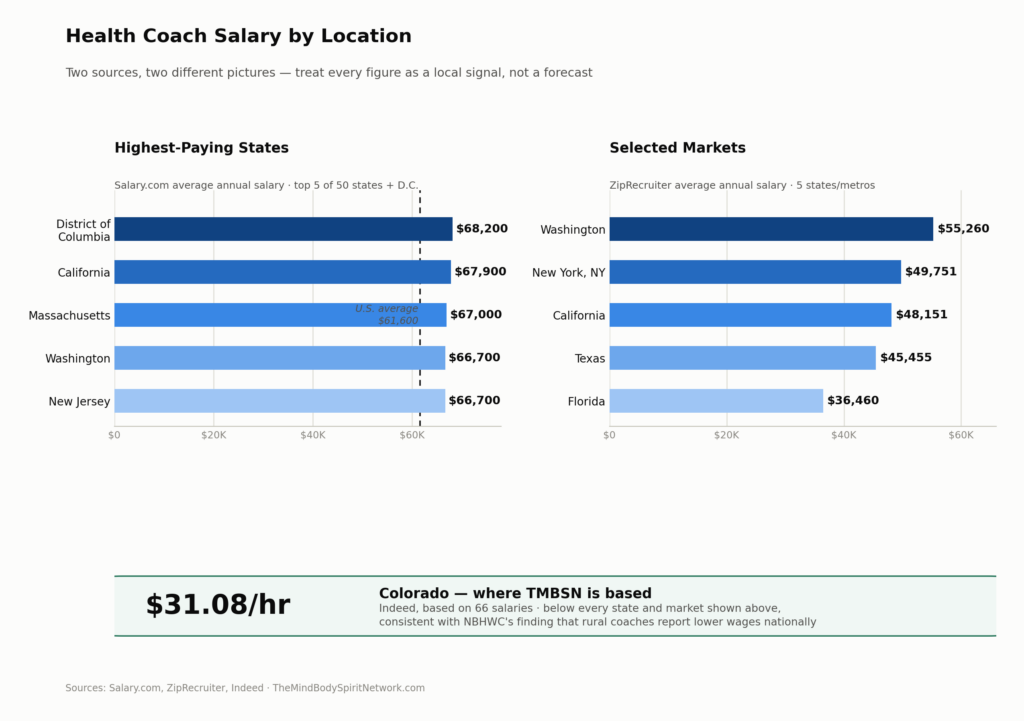
Location moves the number, but treat every figure below as a local signal, not a precise forecast. Sample sizes are small and titles get matched loosely.
Highest-paying states (Salary.com).
District of Columbia ($68,200), California ($67,900), Massachusetts ($67,000), Washington ($66,700), and New Jersey ($66,700) lead, against a U.S. average of $61,600.
Selected markets (ZipRecruiter).
New York, NY averages $49,751. California averages $48,151. Washington state averages $55,260. Texas averages $45,455. Florida averages $36,460. Colorado, where TMBSN is based, lands lower on Indeed’s hourly data at $31.08/hour, with NBHWC’s broader survey noting rural coaches report lower wages than urban and suburban peers nationally.
Does remote coaching change the equation?
Partly. NBHWC found 44% of coaches work exclusively online nationwide, and 62% serve clients in states other than their own. Location still shapes local job postings and in-person rates, but it doesn’t cap you the way it once did.
Does Certification Affect Health Coach Salary?
Credentials improve access and credibility more clearly than they guarantee a specific paycheck. That distinction matters more than most certification marketing lets on.
NBC-HWC and the $50K threshold.
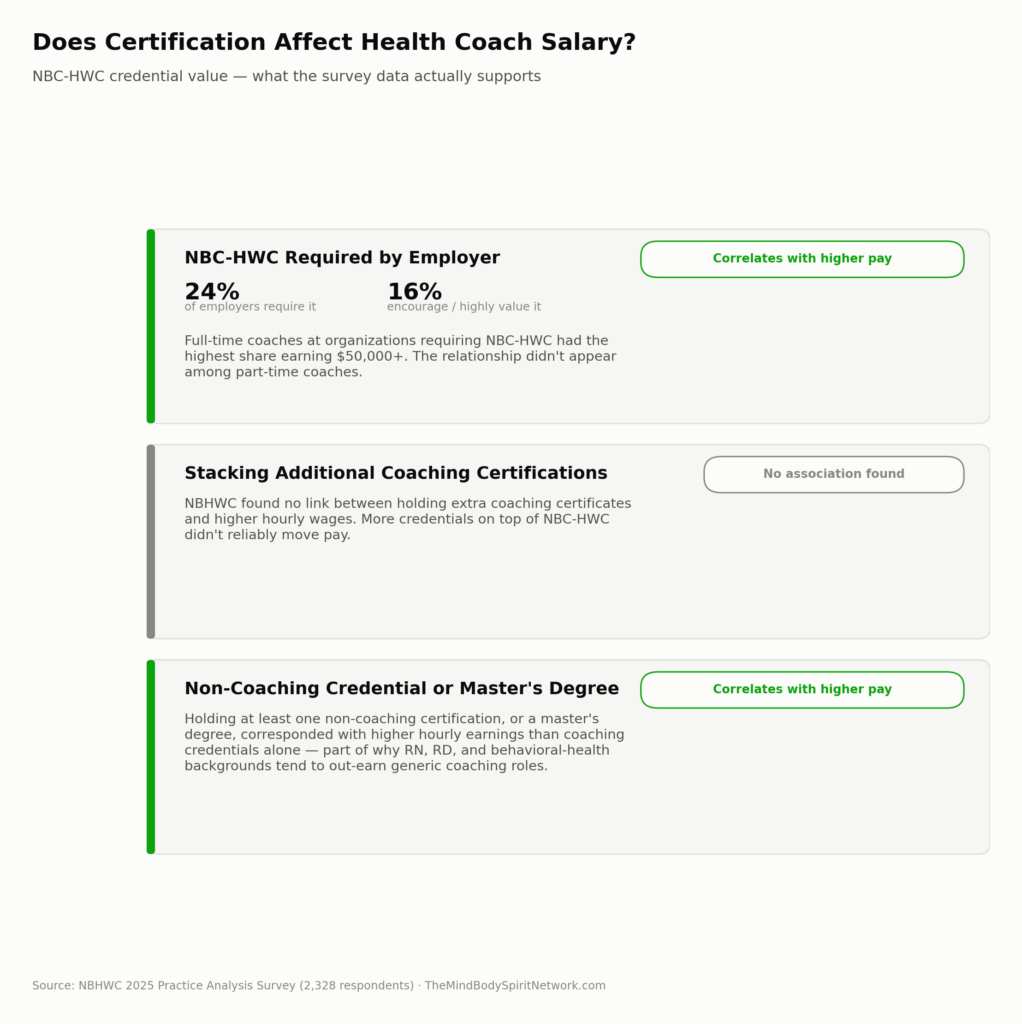
Among full-time coaches, those working at organizations that required NBC-HWC had the highest proportion earning at least $50,000. Employers required the credential for 24% of respondents and encouraged it for another 16%.
Why “more certifications” doesn’t reliably mean “more income.”
NBHWC found no association between additional coaching certifications and higher hourly wages. Stacking coaching credentials on top of coaching credentials doesn’t move your pay the way people assume.
What actually does move the needle.
Holding at least one non-coaching credential, and having a master’s degree, both corresponded with higher hourly earnings in NBHWC’s data. That’s a big part of why RN, RD, and behavioral-health backgrounds tend to out-earn generic coaching roles. This is also where the distinction between a health coach and a nutritionist starts to matter for your income, since scope of practice and licensure requirements diverge sharply between the two. [LINK: Health Coach vs. Nutritionist — Which Path Pays More?]
If you’re choosing a training program, credibility with employers and clients is a real, defensible reason to pick an NBHWC-approved path. We’ve done a full independent review of mindbodygreen’s Health Coach Certification, an NBHWC-approved, 20-week program that also folds in functional nutrition content. If you’re ready to look at it directly, here’s the program. Just don’t expect the certification alone to set your salary. The data doesn’t support that claim, and neither should we.
Realistic Income Timeline: Year 1, Year 2, Year 3+
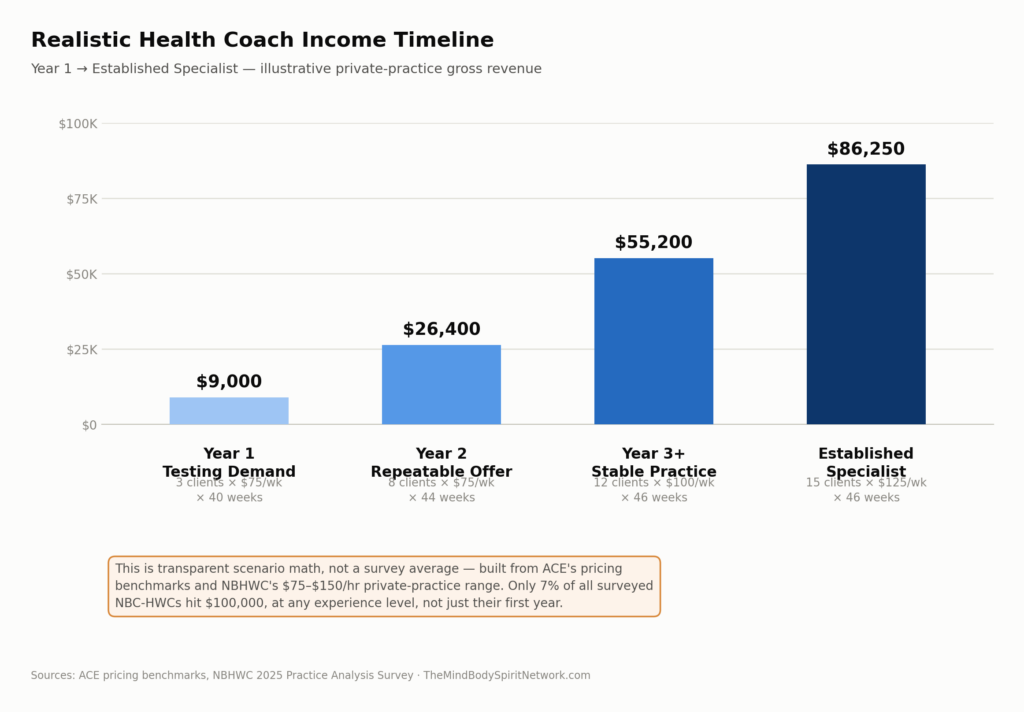
There’s no high-quality national study that tracks newly certified coaches through their first three years. What follows is transparent scenario math, not a survey average, built from ACE’s pricing benchmarks and NBHWC’s common $75–$150/hour private-practice range.
| Stage | Illustrative Workload | Gross Revenue |
|---|---|---|
| Year 1: testing demand | 3 active clients × $75/week × 40 weeks | ~$9,000 |
| Year 2: repeatable offer | 8 clients × $75/week × 44 weeks | ~$26,400 |
| Year 3+: stable practice | 12 clients × $100/week × 46 weeks | ~$55,200 |
| Established specialist | 15 clients × $125/week × 46 weeks | ~$86,250 |
The employed path is usually steadier.
PayScale’s experience data moves from $18.05/hour under one year to $22.81/hour at one to four years. Salary.com’s modeled ladder moves from $58,776 entry-level to $65,831 expert. Slower growth, but far more predictable than private practice.
Don’t plan on six figures in year one. Only 7% of all surveyed NBC-HWCs hit $100,000, at any experience level, not just their first year. Build your budget around the conservative end of these numbers.
What Actually Affects a Health Coach’s Earning Potential
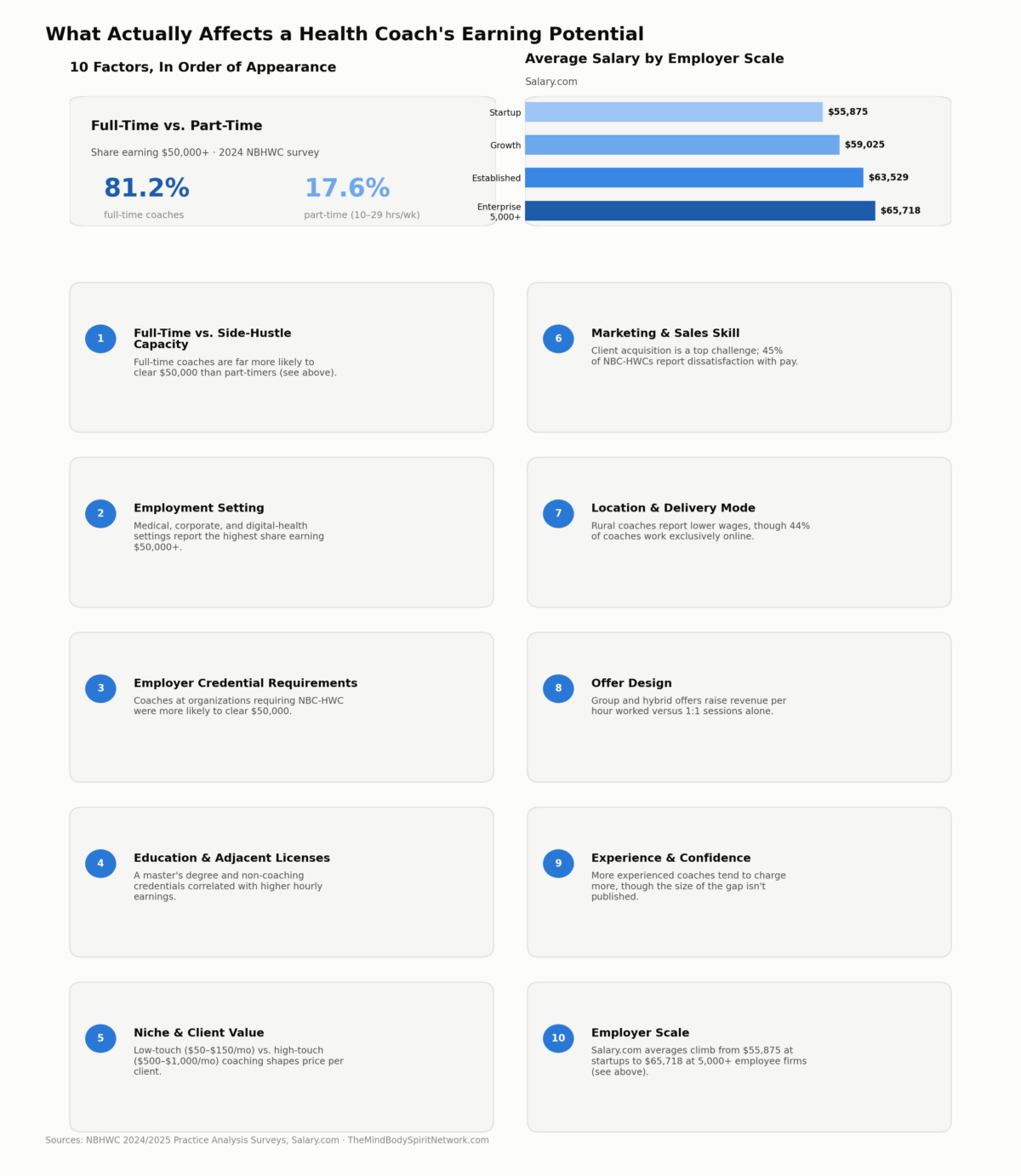
- Full-time vs. side-hustle capacity. In 2024, full-time coaches were far more likely than 10-29-hour part-timers to earn at least $50,000: 81.2% versus 17.6%.
- Employment setting. Medical, corporate, and digital-health settings reported the highest share of coaches earning $50,000 or more.
- Credential requirements at the employer level. Coaches at organizations requiring NBC-HWC were more likely to clear $50,000.
- Education and adjacent licenses. A master’s degree and non-coaching credentials correlated with higher hourly earnings.
- Niche and client value. Low-touch coaching at $50–$150/month and high-touch coaching at $500–$1,000/month show how depth of personalization shapes price.
- Marketing and sales skill. Client acquisition was one of the most commonly cited challenges among NBC-HWCs, and 45% reported dissatisfaction with their pay. A credential without lead generation doesn’t produce a full practice.
- Location and delivery mode. Rural coaches reported lower wages than urban and suburban peers, though 44% coach exclusively online.
- Offer design. Group and hybrid offers raise revenue per hour worked compared to one-to-one sessions alone.
- Years of experience and confidence. More experienced, more confident coaches tend to charge more, though the size of that gap isn’t precisely published.
- Employer scale. Salary.com shows averages climbing from $55,875 at startups to $65,718 at enterprises with 5,000+ employees.
Health Coach Salary vs. Similar Careers
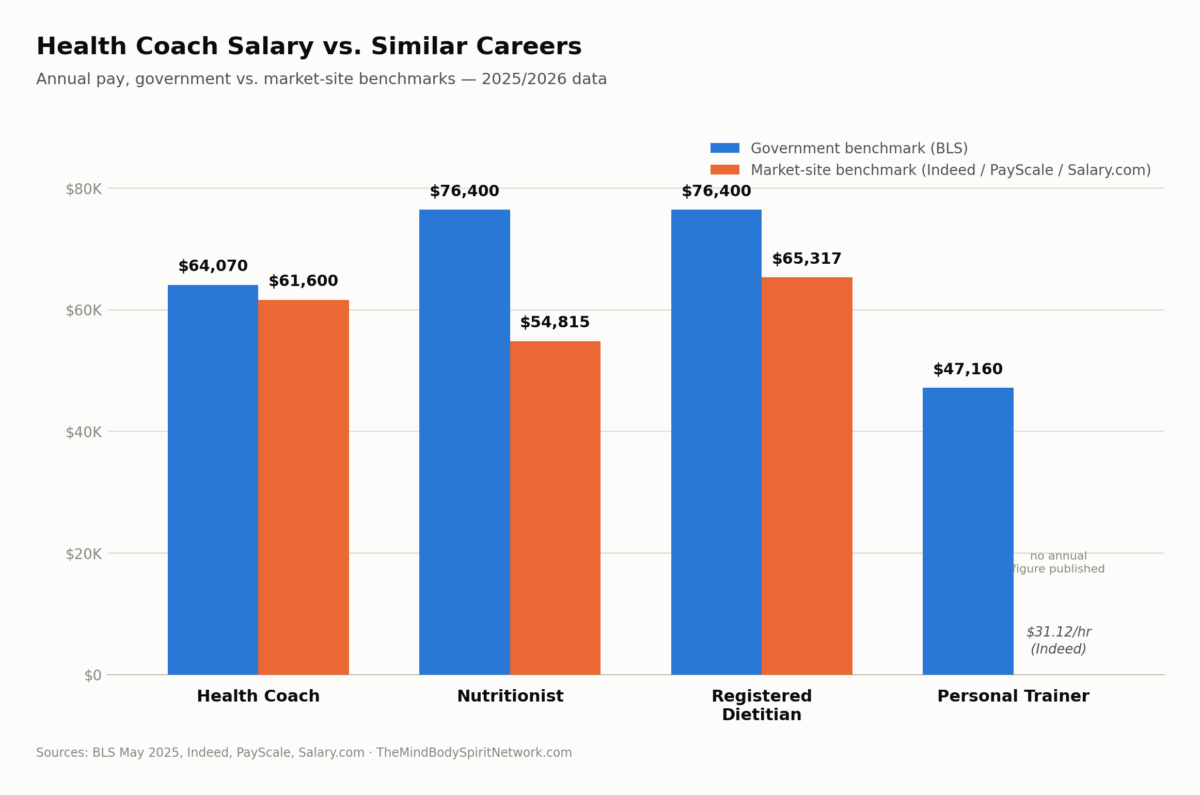
People researching health coaching almost always compare it against a few adjacent careers. Here’s how the government and market data actually stack up.
| Role | Government Benchmark | Market-Site Benchmark |
|---|---|---|
| Health coach | No standalone BLS code; Health Education Specialist proxy: $64,070 | $26.71/hour (Indeed); $61,600/yr (Salary.com) |
| Nutritionist | $76,400 (BLS, combined with dietitians) | $26.00/hour (Indeed); $54,815/yr (PayScale) |
| Registered dietitian | $76,400 / $36.73/hour (BLS) | $42.81/hour (Indeed); $65,317/yr (PayScale) |
| Personal trainer | $47,160 / $22.67/hour (BLS) | $31.12/hour (Indeed) |
Registered dietitians and nutritionists post the most stable numbers here, largely because many states require licensure and the government tracks the role directly. “Nutritionist” as a standalone title is far less regulated, which is exactly why health coach vs. nutritionist is one of the most common questions people ask before choosing a path. [LINK: Health Coach vs. Nutritionist: Which Career Is Right for You?] covers scope of practice, income ceiling, and training length side by side.
How Health Coaches Increase Their Income
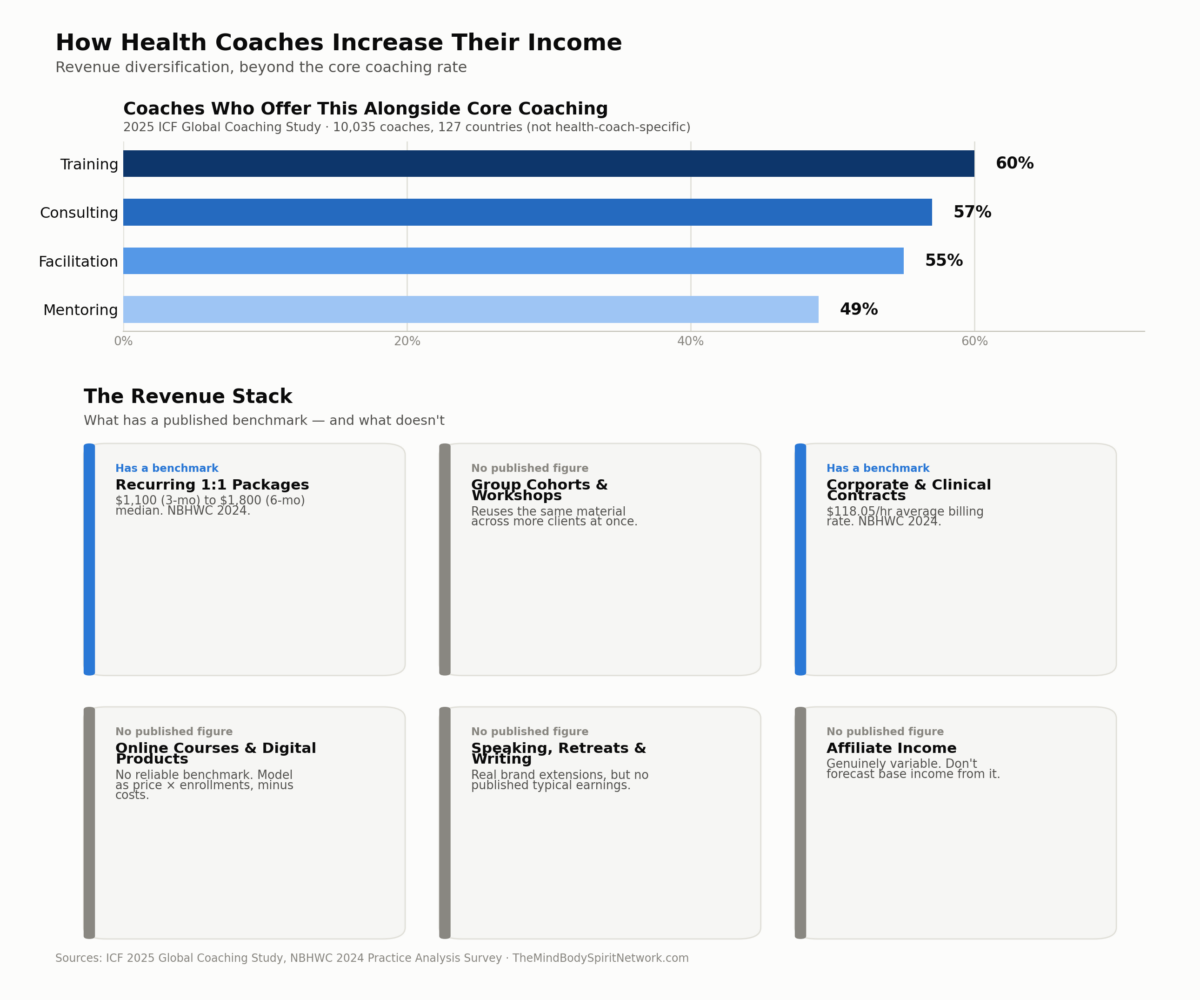
The 2025 ICF Global Coaching Study, drawing on over 10,000 coaches worldwide, found that most professional coaches don’t rely on one income stream. 60% provide training, 57% consulting, 55% facilitation, and 49% mentoring alongside their core coaching work.
Recurring packages over single sessions. A defined three- or six-month program builds predictable cash flow better than one-off appointments.
Group cohorts and workshops. Reuse the same material across more clients at once.
Corporate wellness and clinical contracts. Steadier, often better-paying, though harder to land without a track record.
Online courses and digital products. Add-on revenue, though no reliable national income benchmark exists for this specifically. Model it as price times enrollments, minus platform, production, and refund costs.
Speaking, retreats, and writing. Real extensions of a coaching brand, without published typical earnings.
Affiliate income. Genuinely variable performance marketing revenue. Never build it into a base-income forecast without your own traffic and conversion numbers.
One niche worth naming directly: functional nutrition knowledge tends to raise both your session value and your client outcomes, which is part of why “nutrition coach salary” shows real, distinct search volume of its own. If nutrition is a specialty you want to add rather than a full pivot, mindbodygreen’s Functional Nutrition Training is built to layer onto an existing coaching practice.
The safest sequence, if you’re building from nothing: stabilize one core offer, add a group or workshop that reuses the same expertise, then layer in scalable products. Launching five unvalidated offers at once tends to diversify your attention, not your income.
Is Becoming a Health Coach Worth It Financially?
Financially, health coaching is achievable, not automatic. The honest range is $45,000 to $70,000 employed, with real six-figure potential in private practice that only about 7% of board-certified coaches currently reach.
What separates the coaches earning $70,000-plus from the ones earning under $10,000 isn’t usually more certifications. It’s business skills: pricing confidence, consistent client acquisition, and a structured offer instead of open-ended sessions. If you’re serious about the business side, not just the coaching side, our pillar guide on starting a holistic health coaching business walks through certification, niche, pricing, and client acquisition step by step.

Introducing mindbodygreen Health Coaching
mindbodygreen.com has tapped the top doctors, wellness professionals, and board-certified health coaches to create comprehensive training that will help transform your passion into purpose, elevate your existing wellness practice or even help address ongoing health concerns.
Our well-rounded and science-based teachings will ensure that you’re confidently equipped with expertise across a full spectrum of conditions, backgrounds, and belief systems and are taught by today’s experts to build tomorrow’s leaders.
*According to our consciousness calibrations, mindbodygreen’s Holistic Health Coaching Program calibrates at 360 on the Map of Consciousness® (or 10 to the 360th power), a significant energy level in consciousness research. It is the same energy field as the concept of “healthy). This is what sets us apart at The Mind Body Spirit Network. We vet online courses that are of higher consciousness and trustworthy.
Check Out Our Library of Posts
in Support of Your Becoming a Health Coach
Become a “Best-in-Class” Certified Health Coach in Only 20 Weeks
Starting a Holistic Health Coaching Business: What to Know First
Upgrading You Holistic Health Coaching Skills: The Symphony of Body, Mind, & Spirit
Thinking About Health Coaching? Here’s a Respected Certification Path
Earn Your Holistic Health Coach Certification and Change Lives
Mastering the Art of Women’s Health Coaching: Blueprint for a Thriving Business
Marketing for Coaches Without Burnout: The Shift From Hustle to Infrastructure
10 Tips to Build Your Personal Brand Grow Your Life Coaching Business Online
How to Start Your Life Coaching Business Online
Top 7 Benefits of Group Coaching to Boost Your Business
Role of a Brand Marketing Strategist in Branding for Coaches
Frequently Asked Questions
What is the average salary for a health coach?
Employed health coaches typically earn between $45,000 and $70,000 a year, based on independent data from ZipRecruiter, Salary.com, PayScale, and Indeed. There’s no official government wage series for the title, so treat any single “average” with some skepticism.
What is a health coach’s salary per hour?
Indeed reports $26.71/hour and PayScale reports $25.74/hour for employed roles, both based on job-posting and self-reported data. Private-practice session rates run separately, with a $100/hour median, though that’s gross billing, not an hourly wage.
Can health coaches make six figures?
Yes, but it’s not typical. Only 7% of NBC-HWC survey respondents reported earning $100,000 or more from coaching in 2025. It’s a realistic long-term goal for an established private practice, not a starting expectation.
Do health coaches get paid well without certification?
Some do, especially in informal or entry-level settings, but most employers and higher-paying corporate or clinical roles expect an NBHWC-approved credential. Certification opens doors more reliably than it raises pay on its own.
How much do online health coaches make?
It depends heavily on model. Precision Nutrition describes low-touch online coaching at $50–$150 per client monthly with high client volume, and high-touch coaching at $500–$1,000 per client monthly with far fewer clients. Both are gross revenue figures before expenses.
Is health coaching a good side income?
It can be, with realistic expectations. In NBHWC’s data, coaches working 10 to 29 hours a week were far less likely to clear $50,000 than full-time coaches (17.6% versus 81.2%). As a side income testing the waters, a few hundred to a few thousand dollars a month is a realistic early target.
Ready to Build the Income, Not Just Chase the Number?
The salary data tells you what’s realistic. It doesn’t build your practice for you. If you haven’t started yet, our step-by-step guide to starting a holistic health coaching business covers certification, niche, and your first clients in order. If you’re already certified and the number you’re earning doesn’t match the one in this article, the gap is almost always pricing or pipeline, not your ability. Start there.
Sources & Citations
Every figure in this post ties back to one of the primary sources below. Salary and job-market data changes often, so dates are noted where the source provides them.
1. National Board for Health & Wellness Coaching — 2025 Annual Survey Report
https://nbhwc.org/wp-content/uploads/2026/01/NBHWC-Annual-Survey-Report-2025.pdf
Survey of 2,328 board-certified health and wellness coaches, the most direct profession-specific income data available.
Supports: income distribution (36% under $10K, 34% at $50K+, 7% at $100K+), self-employment rate, work status, session pricing, credential findings.
2. National Board for Health & Wellness Coaching — 2024 Annual Survey Report
https://nbhwc.org/wp-content/uploads/2025/09/NBHWC-Annual-Survey-Report-2024-1.pdf
Prior-year NBHWC survey with fuller work-status and package-pricing detail.
Supports: package pricing table, corporate/medical setting wage breakdowns, full-time earning thresholds.
3. ZipRecruiter — Health Coach Salary
https://www.ziprecruiter.com/Salaries/Health-Coach-Salary
Independent job-market salary estimate based on current listings.
Supports: national salary range, state and city-level comparisons.
4. Salary.com — Health Coach Salary
https://www.salary.com/research/salary/alternate/health-coach-salary
Composite salary estimate using employer postings and compensation survey inputs.
Supports: national salary range, experience ladder, state-level averages, employer-size averages.
5. PayScale — Health Coach Salary
https://www.payscale.com/research/US/Job=Health_Coach/Salary
Employee-reported survey and compensation-modeling data.
Supports: hourly wage figures, experience-based pay progression.
6. Indeed — Health Coach Salaries
https://www.indeed.com/career/health-coach/salaries
Based on 2.8K salary observations from job postings over the trailing 36 months.
Supports: hourly wage average, observed range, city-level figures.
7. U.S. Bureau of Labor Statistics — Dietitians and Nutritionists
https://www.bls.gov/ooh/healthcare/dietitians-and-nutritionists.htm
Government occupational wage data.
Supports: nutritionist/dietitian salary comparison.
8. U.S. Bureau of Labor Statistics — Health Education Specialists
https://www.bls.gov/ooh/community-and-social-service/health-educators.htm
Closest government occupational proxy to “health coach.”
Supports: explanation of why no standalone BLS health coach code exists.
9. U.S. Bureau of Labor Statistics — Fitness Trainers and Instructors
https://www.bls.gov/ooh/personal-care-and-service/fitness-trainers-and-instructors.htm
Government occupational wage data.
Supports: personal trainer salary comparison.
10. American Council on Exercise — What to Charge as a New Health Coach
https://www.acefitness.org/continuing-education/certified/health-coaching-special-issue/9144/what-to-charge-as-a-new-health-coach-a-confident-practical-approach/
Pricing examples for one-to-one and group coaching offers.
Supports: group program revenue examples, income timeline scenario math.
11. Precision Nutrition — Health Coach Salary
https://www.precisionnutrition.com/health-coach-salary
Business-model income ranges based on internal data and coach interviews.
Supports: low-touch and high-touch online coaching revenue ranges.
12. International Coaching Federation — 2025 Global Coaching Study
https://coachingfederation.org/resources/research/global-coaching-study/
Survey of 10,035 coaches across 127 countries.
Supports: revenue diversification statistics (training, consulting, facilitation, mentoring).


Leave a Reply